
Trained & Qualified NJ Divorce Attorney-Mediator
Divorce Mediation:
You Design Your Future
You've both landed in the same quiet place: you stopped growing together, and it's better if you're apart. What comes next doesn't have to get nasty, and it doesn't have to cost you everything you've built.
Flat fee packages, so you know the cost before we begin. Most mediations finish in months, not the years a contested divorce takes.

Navesink River, Monmouth County
Mediation Basics in New Jersey
Mediation is a conversation with a guide. I'm the neutral in the room, which means I'm not on anyone's side and I'm not deciding anything for you. My job is to keep you both talking, ask the questions that get at what actually matters, and help you land somewhere you can both live with.
The process is structured enough to keep us moving, flexible enough to sit with an idea until it works. Nobody hands down a ruling. You two decide. We work through the real details: the marital home, the pet, the wine cellar. I help you organize your finances and schedules so you can have productive conversations about splitting money, assets, and time with your kids. At the end, I draft a Memorandum of Understanding capturing every nuanced agreement, from parenting plans to equitable distribution.
You take that completed MOU to an attorney to draft the Marital Settlement Agreement and file in New Jersey. No Discovery costs, no drawn-out lawyer correspondence, no months of legal bills.
You avoid the courtroom, the expensive attorneys, and the long waiting times, and your paperwork gets cut down dramatically. Best of all, the two of you stay in charge of the outcome instead of handing that decision to someone who has never met your family.
New Jersey mediation is governed by the Uniform Mediation Act, and every state has its own version.
Mediation is voluntary. Nobody can force you into an agreement, and you can stop at any point.
There is one wrinkle worth knowing about. If you're already inside a court proceeding, the court will send you to mediation as part of that process. That's a different animal from what happens here. Court mediation runs on someone else's calendar, with someone else's rules, and it's one stop on a track you didn't lay down.
Private mediation is yours. You choose the mediator, you set the pace, and you decide what ends up in the agreement. Nobody is deciding for you and you're free to make any decision that works for you regardless what the law says.
You don't need a lawyer to mediate. The fear is that without one you'll get taken advantage of, and that fear isn't silly. But the real risk is an insincere mediator, and that's not how I work.
If I see an imbalance, I stop and send you both to your own attorneys before we go any further. Two moments where a lawyer earns their keep: when something comes up that you can't get past, and at the end, when your Memorandum of Understanding gets reviewed by independent counsel and turned into the Marital Settlement Agreement.
That document is the map for your new life. Have someone read it.
Pick the Plan That Works for You
Most couples can complete a mediation under 10 hours over a few weeks or months.
Separate drafting fee for MOU, not to exceed $550.
Mediation typically costs a fraction of a traditional divorce. Third party surveys put the average New Jersey divorce at roughly $12,500 to $15,000, but neither the New Jersey Judiciary nor the State Bar publishes fee data, so treat that as an average, not a quote. Your case is its own.
We're happy to offer a 10% discount to teachers and police officers and healthcare workers* in recognition of their service to our community.
*anyone primarily engaged in actions whose intent is to enhance health and wellness.
Who We Serve
No Two Families Untangle the Same Way
What mediation looks like depends on who is at the table, whether there are children, whether you were ever married, and what each of you is trying to protect.
Parents
Parenting plans built around real Tuesday nights, not court templates. Schedules, holidays, decision-making, and how you will handle the things you cannot predict yet.
Couples without children
Property, support, and a clean close. Often the fastest and least expensive route through a divorce, and the one where mediation saves the most.
Same-sex and LGBTQ+ couples
Relationships that began long before marriage equality, non-biological parent standing, second-parent adoption, the questions a standard form never anticipates.
Unmarried and cohabiting partners
A shared home, shared money, and often shared children, with no marriage to dissolve. You still need agreements that hold up.
Later-in-life divorce
Retirement accounts, pensions, health coverage, and adult children with opinions. Decades of joined finances to unwind carefully rather than quickly.
Pet families
New Jersey treats pets as property. Mediation is where you can build a real sharing arrangement instead of asking a judge to pick a winner.
However you come to the table
Self-represented
No attorney? Mediation is the whole process, not a step inside someone else’s.
Represented by counsel
Your attorney stays in the loop. Nothing is signed before they review the Memorandum of Understanding.
Collaborative divorce
Collaboratively trained (forthcoming) and able to work as part of a collaborative team.
Court-referred
Rule 1:40 qualified for Superior Court referrals in family (forthcoming) and civil matters.

Experienced Divorce Mediator Helping You Organize and Overcome a Difficult Time
Answers to the most asked questions
What are you actually getting for your money with P8 Mediations?
More than a cheaper divorce. Yes, the price is a fraction of what litigation costs, but that was never really the point. The real value is in how you come through this, and who you are on the other side. Here's what you're getting:
Mediator judgment. You're working with a mediator who's also an attorney, someone who knows how equitable distribution actually works in New Jersey and can read the room at the same time. I lead with my intuition. And if I ever see an imbalance, or someone being taken advantage of, I stop and tell you both to go consult your own attorneys before we move forward. That judgment is what keeps the whole thing fair.
Support through the process. I don't hand you a verdict and send you on your way. I walk two people, calmly and one step at a time, through untangling what marriage tied together. When it starts to feel like a lot, and it will, we slow down. It's okay to not get it; it's a lot. You're gonna be okay, and I'll help you.
Access to a curated network of professionals. When you need a financial specialist, a therapist, a real estate expert, or an attorney for a particular step, you're not starting from a blank search bar. You get access to a curated network of professionals I know and trust, the right person for the moment, already vetted.
Care and attention. You get lived empathy, not performed empathy. I genuinely care whether the deal is fair, and I'm generous with my time.
Speed. Because we're collaborating instead of fighting, this moves. Most mediated divorces finish in three to five months instead of the year-plus a contested case can drag on, which means less money spent, and far less of your life spent living in limbo.
You walk in frightened and confused and walk out steadier and in charge, with a memorandum of understanding you shaped yourself, a clear map of what your life is actually going to look like, with the kids and with the assets and liabilities you've split. That's the value.
Is there a best time of year to get divorced?
When you're both ready. That matters more than any date on the calendar, and no tax benefit is worth staying married for.
There are a few real timing details though. Your marital status on December 31 sets your tax filing status for the whole year, and the capital gains exclusion on the family home drops from $500,000 to $250,000 per person once you're divorced. Both are worth knowing before you pick a finalization date.
What if mediation doesn't work?
There are no guarantees that every issue will be resolved in mediation, and it's fair to ask what happens if it doesn't. You lose very little by trying. Mediation is non-binding, so nothing is final until you both sign a settlement agreement, which means you keep every legal right you started with, including the option to go to court.
If you can't reach a full agreement, the progress you made isn't wasted. Any issues you did settle can be put in writing and carried forward, which narrows what's left and usually saves time and money if the case proceeds. From there you have options: return to mediation later once emotions have settled, move to a collaborative divorce, use arbitration for a binding decision on what remains, or proceed to litigation. Even a partial agreement leaves you further ahead than starting from scratch in court.
Most couples who come to mediation in good faith do reach a full agreement. But I'll be honest with you about how things are progressing, and if mediation isn't serving you, I'll help you understand your next step rather than keep you in a process that isn't working.
We were together for years before we could legally marry. Will our whole history count?
New Jersey often starts the clock at the date you legally married or entered a civil union, not the day your life together actually began. For couples who built a home, a life, and savings together for years before marriage was legal, that can matter a great deal.
That's exactly where mediation gives you something a courtroom can't: you two decide. Instead of leaving it to a judge who may only see the certificate date, you can build an agreement on your real history.
More for same-sex couples untangling a pre-2013 relationship →
Is mediation right for every couple?
Mediation works best when both spouses are willing to communicate and negotiate in good faith, even if you don't currently agree on much. It's a strong fit for the majority of divorces. Cases involving abuse, a serious power imbalance, or a spouse who refuses to participate honestly may need a different approach and we'll tell you candidly if we think that's the case.
Is there any free or low-cost mediation available?
Yes. New Jersey's court-connected mediation program provides the first two hours of a roster mediator's time at no charge under Court Rule 1:40-4(b), which works out to one hour of preparation and one hour in the room. After that, mediators charge their standard rates, shared between the parties. Private mediation, like the service we offer at P8, gives you more flexibility over scheduling, pace, and the mediator you work with.
What are the court filing fees in New Jersey?
Court filing fees are set by the state and apply no matter how you resolve your divorce. The spouse who files pays $300 ($325 if there are children), and the responding spouse pays $175. These are separate from any attorney or mediator fees.
Court filing fees and the free-mediation provision are set by the New Jersey Courts. This information is for general education and is not legal advice.
What does a divorce cost in New Jersey?
It depends almost entirely on how you resolve it. A contested divorce that involves discovery, negotiation, and court appearances commonly costs $15,000 to $35,000 per spouse, and a high-conflict case that goes to trial can exceed $50,000 to $100,000 per spouse. A complete mediated divorce typically runs $3,000 to $8,000 total, shared between the two of you rather than duplicated by two separate attorneys. Most mediated cases finish in three to five months, against 12 to 18 months for a contested one.
The single biggest driver of cost isn't your assets or your paperwork. It's conflict, and how long the process stays open.
Latest Insights

You're an Influencer Getting Divorced. Does Your Spouse Get Part of Your Business?

We Were Together Long Before We Could Marry. Does Our History Count?

Is There a Best Time of Year to Get Divorced?

What Does a Divorce Actually Cost in New Jersey?
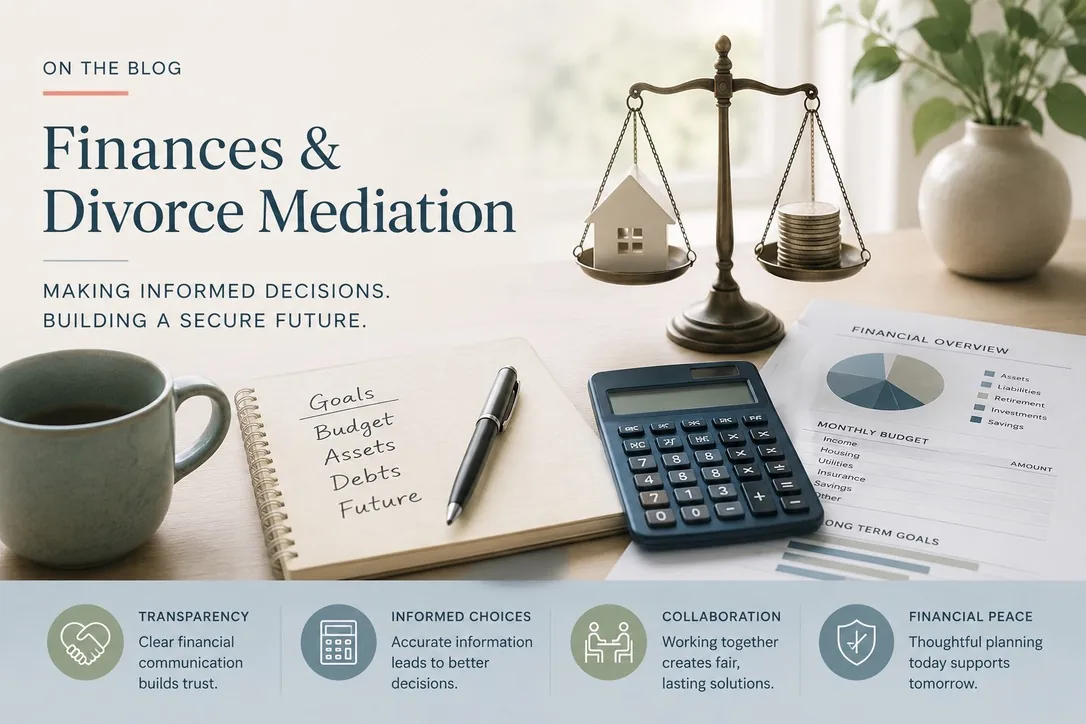
Money and Divorce Mediation: How to Face Your Finances

What Happens to the House? Untangling Home Equity in a New Jersey Divorce

How Does Equitable Distribution Work in NJ Divorce
Thirty minutes, no charge, no commitment. I'll learn a little about where things stand and walk you through how I work. Bring your questions, even the ones you think are dumb.